 goodword
Why all-you-can-eat Korean fried chicken is getting attention in Vancouver — and how to price it
AYCE Korean fried chicken works because it feels rare, value-heavy, and easy to film. Here is what it is, why it is moving, and how to keep the math sane.
The short version
- AYCE Korean fried chicken is working as a promo format, not just a menu item.
- The hook is value plus novelty. That is why it is getting traction in Vancouver food content.
- A time cap, dine-in rule, and tight sauce choices help protect margin.
What this is
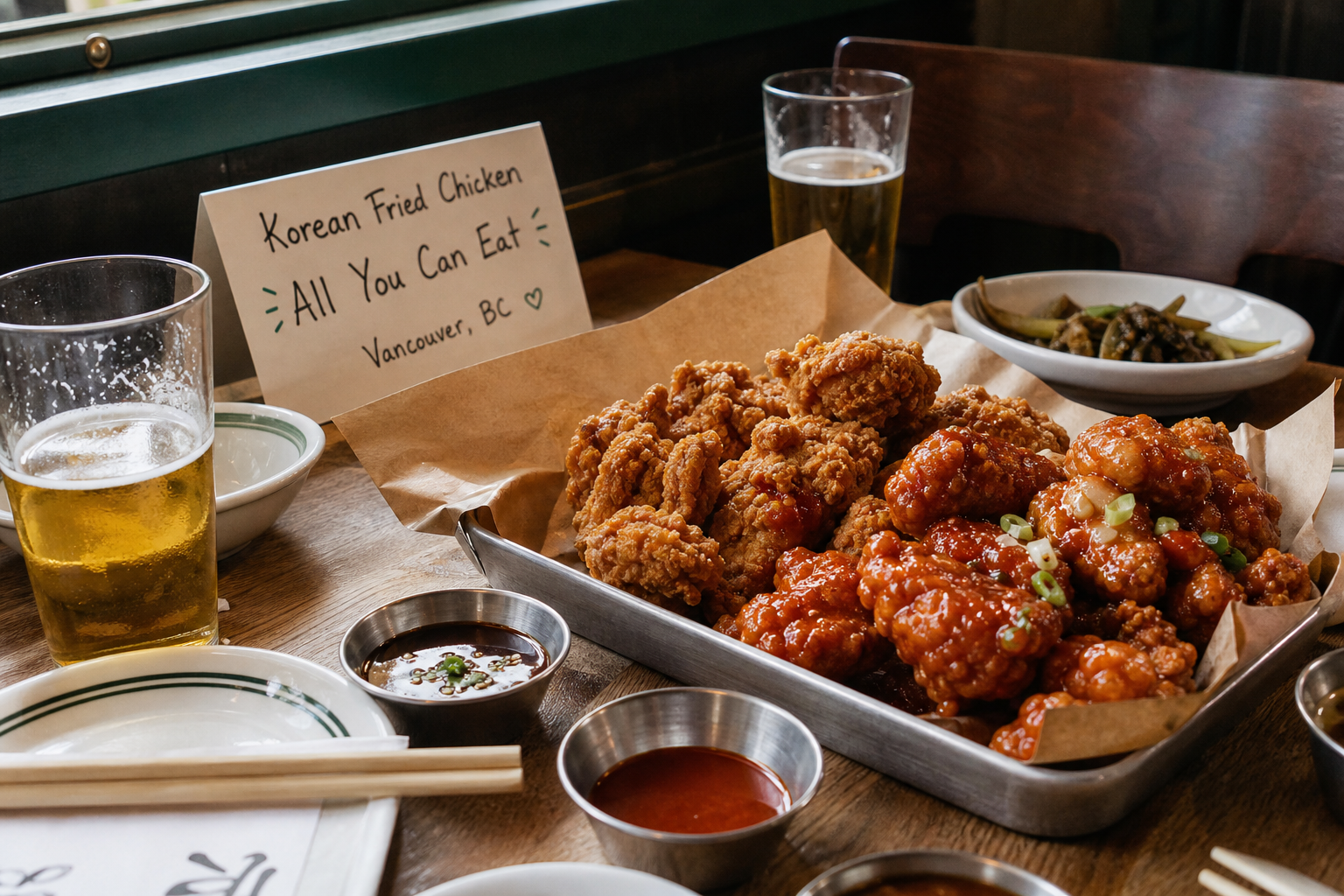
All-you-can-eat Korean fried chicken is a fixed-price, dine-in special where guests can keep ordering rounds of chicken during a set time window.
The product itself is familiar. Korean fried chicken is usually double-fried for extra crispness, then served plain or tossed in sauces like soy garlic or sweet-spicy yangnyeom. It often comes with pickled radish. Korean tourism sources point to that double-fry method as the signature. [^1]
The AYCE part is the change. Instead of selling one basket or one plate, you are selling an experience. That makes it feel more like hot pot or Korean barbecue than a normal fried chicken order.
Why it is surging in Vancouver
The local signal is real. A recent Vancouver TikTok post called out “ALL-YOU-CAN-EAT KOREAN FRIED CHICKEN?!” as something the creator had never seen before. That matters because rarity travels well online. It gives people a reason to stop scrolling.
The broader Vancouver food feed also rewards three things:
- value
- novelty
- a clear deal
That same pattern shows up in other recent posts about cheap eats, hidden spots, and limited-time specials. AYCE Korean fried chicken fits that lane very cleanly.
There is also a larger market reason. Statistics Canada says food purchased from restaurants was up 3.0% year over year in May 2026. When guests feel prices climbing, a fixed-price offer looks safer. [^2]
Industry reporting points the same way. Gordon Food Service’s Spring 2026 trends newsletter flags Asian QSRs, including Korean fried chicken, as booming. That is not a Vancouver-only stat, but it is a useful signal. [^3]
And the base category is already established in the city. Vancouver menus already show Korean fried chicken in a range of formats and price points, so AYCE does not need to teach the customer what the food is. It only needs to make the math feel worth it. [^4]
A simple origin story
Korean fried chicken did not start as a trend item in North America. It grew in Korea as a local version of fried chicken that leaned into crispness, cut-up pieces, and sauce.
Official Korean sources describe the style as double-fried and tied to the rise of chimaek culture, the pairing of chicken and beer. Korean policy and tourism sources also place the growth of sauced versions like yangnyeom chicken in the early 1980s. [^1][^5]
That history matters for operators because it explains why the food is so shareable. It is already built around social eating.
Simple kitchen version
Here is a stripped-down version that matches the category.
Ingredients
- 1 kg chicken wings or thighs
- salt and pepper
- 1 cup potato starch or cornstarch
- 1/2 cup flour
- neutral frying oil
Soy garlic sauce
- 2 tbsp soy sauce
- 1 tbsp honey or corn syrup
- 1 tbsp sugar
- 2 cloves garlic, minced
- 1 tsp sesame oil
Sweet-spicy sauce
- 2 tbsp gochujang
- 1 tbsp ketchup
- 1 tbsp honey or corn syrup
- 1 tbsp sugar
- 1 tbsp soy sauce
- 1 clove garlic, minced
Method
- Season the chicken.
- Coat lightly in starch and flour.
- Fry once at moderate heat.
- Rest it.
- Fry again hotter for a crisp shell.
- Toss in sauce or serve sauce on the side.
- Finish with sesame seeds and pickled radish.
The second fry is the big one. That is what gives the chicken its crunch.
Pricing it without losing money
AYCE looks simple. It is not. Your job is to price for the second and third round, not just the first plate.
A good starting point is to set a guardrail around food cost and then decide what the promo is for.
A margin-safe framework
| Scenario | Estimated food cost per guest | Suggested menu price | Food cost % |
|---|---|---|---|
| Light eater, 2 rounds max | $7–9 | $22–26 | 27%–41% |
| Typical guest, 3 rounds | $9–12 | $28–34 | 26%–43% |
| Heavy eater, sauce-heavy, more waste | $12–15 | $36–42 | 29%–42% |
These are working ranges, not published Vancouver benchmarks. The point is to protect the business if a table eats more than expected.
Rules that help the math
- Dine-in only.
- Time cap of 60 to 90 minutes.
- One flavor per round.
- Small rounds, not huge trays.
- Limit the offer to wings or boneless, not both.
- Charge for waste if the policy is clear.
- Push drinks and sides separately.
That structure keeps the offer fun while limiting open-ended cost.
A practical owner read
The trend is not really about free refills. It is about a clear value story.
Guests understand the offer in one second:
- this is rare
- this is filling
- this is worth filming
- this is less scary than ordering two full plates
That is why it can drive traffic.
The danger is assuming the buzz means profit. It does not automatically do that. If the chicken gets buried under too many sauces, too much waste, or too much labor, the promo can look busy and still bleed cash.
That is where good records matter. If you run a special like this, you need to know whether each round is actually making money, and goodword’s POS and inventory tracking help an owner see that in plain numbers.
[^1]: Jeonju Excursion > K-Culture > K-Food > Chicken
[^2]: The Daily — Food services and drinking places, May 2026
[^3]: TRENDS SPRING 2026 NEWSLETTER ASIAN QSRs BEVERAGE
[^4]: Ole's Korean Fried Chicken | Ole Chicken
[^5]: 돌아왔다! 치맥의 계절 - 정책뉴스 | 뉴스 | 대한민국 정책브리핑
Questions owners ask
How do you price all-you-can-eat Korean fried chicken so it does not lose money?
Start with a food-cost target and price for the guest who takes three rounds, not the guest who takes one. In practice, that usually means a dine-in price in the high $20s to low $40s, depending on portion size, sauce cost, and waste control.
What rules help protect margin on AYCE fried chicken?
Use a time cap, keep it dine-in only, limit flavors per round, and keep portions small. A clear waste policy also helps.
Why is this format getting attention in Vancouver?
It combines novelty with value. Vancouver food content tends to reward rare deals and easy-to-understand specials, and restaurant prices have also been rising.
Sources
- Ole's Korean Fried Chicken | Ole Chicken
- Jeonju Excursion > K-Culture > K-Food > Chicken
- The Daily — Food services and drinking places, May 2026
- TRENDS SPRING 2026 NEWSLETTER ASIAN QSRs BEVERAGE
- 돌아왔다! 치맥의 계절 - 정책뉴스 | 뉴스 | 대한민국 정책브리핑
- PRESS RELEASE
- 코리아나-K-uisine > 상세화면
- Fried Chicken: Find it in Daegu, Korea’s Crispy Capital- VISITKOREA
- Food Price Data Hub
- Pricing Orders - BC Chicken Marketing Board
- Order CM Chicken (Kitsilano) - Menu & Prices - Vancouver Delivery | Uber Eats
- Order Damso (Robson) - Menu & Prices - Vancouver Delivery | Uber Eats
- Commander d'un Todak Todak Korean Chicken Restaurant〖Menu et prix〗| Vancouver | Uber Eats
- Order Online
- Order Prinkle Chicken & K-Taco (1st Ave) - Menu & Prices - Vancouver Delivery | Uber Eats
- Zabu Chicken | Menu | Vancouver, BC, Canada
Test the special before you scale it
If you are running AYCE Korean fried chicken, track each round, sauce mix, and waste line by line. goodword keeps the order flow, inventory, and customer list in one place so you can tell if the promo is filling seats or actually making money.
Start with goodword →