 goodword
Why Brazilian churrasco is showing up on Vancouver menus — and how to price it
The rodízio format gives guests abundance and gives owners a clean fixed-price model, but only if the meat mix and portion control are tracked closely.
The short version
- Brazilian churrasco is usually served rodízio-style: fixed price, continuous tableside carving, and a mix of meats and sides.
- Vancouver social posts show real local interest in all-you-can-eat Brazilian steakhouse dining.
- A safe pricing model depends on meat mix, portion control, and a target food cost that leaves room for labour and waste.
Brazilian churrasco is not just “steak night”
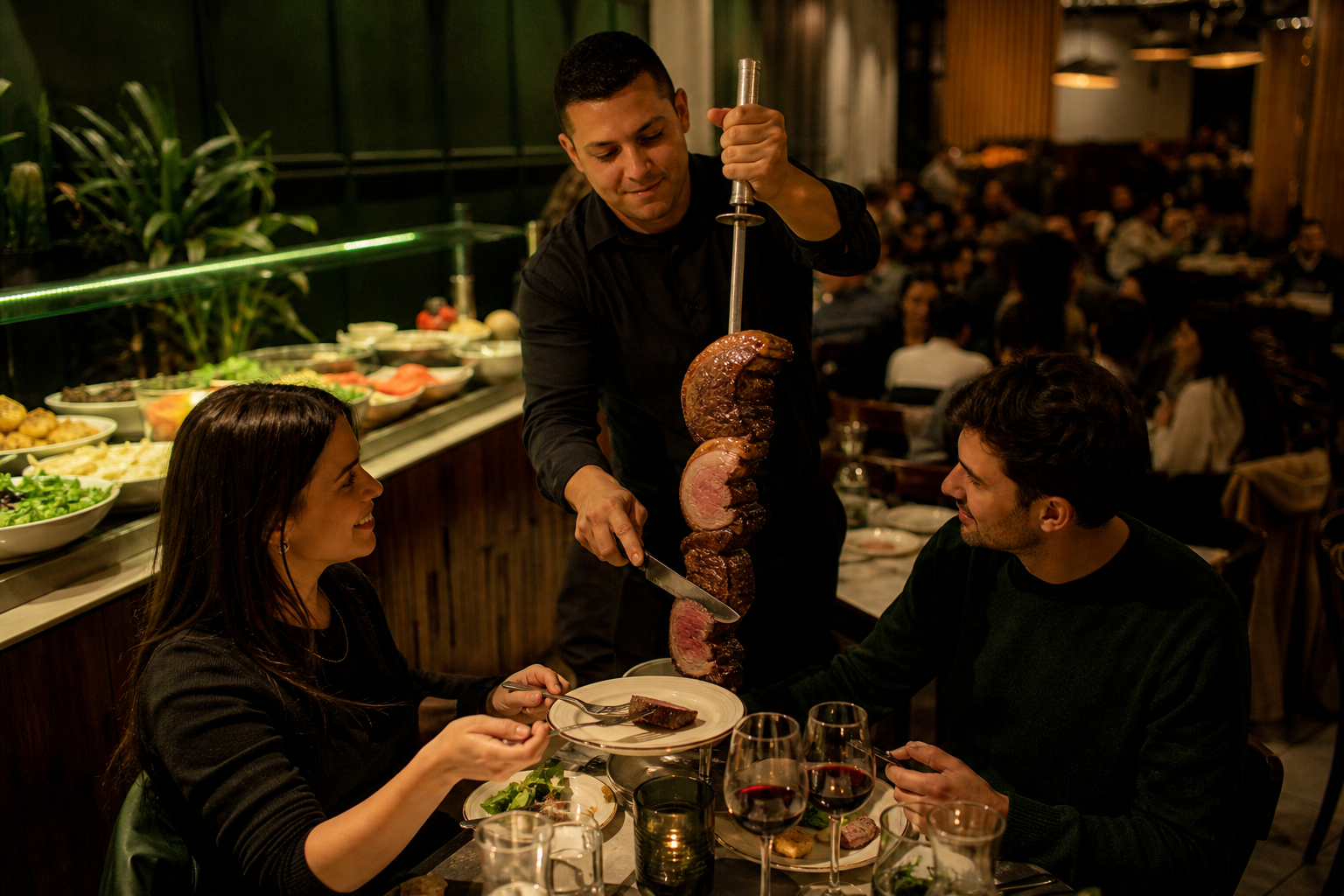
Brazilian churrasco is a fire-roasted meat tradition. In restaurant form, it is usually served as rodízio: guests pay one fixed price and servers keep bringing skewered meats to the table until they stop. That is the whole appeal. Abundance. Choice. No ordering every round. [1][2]
For Vancouver owners, that matters because the format is easy to explain and easy to film. A platter of carved meat reads well on social. So does a server coming around with another skewer of picanha or sausage. It feels like an event, not a dinner.
Vancouver already has local examples of the format, including Rio Brazilian Steakhouse on Denman Street, which positions itself around Brazilian BBQ and rodízio dining. [2]
Why it is getting attention in Vancouver
Your TikTok sample gives the clearest signal. One local post from @eatcouver specifically called out “this all-you-can-eat brazilian steakhouse experience in vancouver” and reached roughly 180k with a 5.2% engagement rate. That is strong evidence that the format is legible to local food audiences, not just niche to one room.
There are a few reasons that matters right now:
- It is visual. Tableside carving is made for short video.
- It feels like value. Guests see multiple cuts, sides, and salad table access in one price.
- It fits group dining. Birthdays, date nights, and meat-heavy dinners all fit the format.
- It is already part of the North American premium dining playbook. Major operators market churrasco as a fixed-price experience in the roughly US$59–65 range. [3][4]
That lines up with a wider dining environment where full-service restaurants are still seeing movement, even as menu prices stay under pressure. Statistics Canada reported full-service restaurant sales up in February 2026, and food purchased from restaurants up year over year. [5]
What churrasco actually is
At the table, churrasco is simple:
- skewered meats
- open-fire or high-heat roasting
- coarse salt and light seasoning
- carving straight to the plate
The signature cut is often picanha, the top sirloin cap. It is prized because the fat cap bastes the meat as it cooks. That gives you a lot of flavour without a long ingredient list. Fogo de Chão identifies picanha as a flagship cut in its churrasco experience. [4]
A simple churrasco recipe you can test in service
Picanha-style churrasco
Ingredients
- 1 whole picanha / top sirloin cap
- Coarse salt
- Black pepper, optional
- Lemon, chimichurri, or grilled pineapple on the side
Method
- Trim only the excess silver skin. Leave the fat cap.
- Slice thick against the grain, or curve the cut onto skewers.
- Season with coarse salt.
- Roast over high heat or charcoal until the fat renders and the outside browns.
- Rest briefly, then slice and serve.
That is the core of the format. It is not a complicated sauce business. It is a meat and fire business.
Where the idea comes from
Churrasco comes from southern Brazil, especially Rio Grande do Sul, where ranching and gaucho cookery shaped open-fire meat traditions. The restaurant-service version, rodízio, came later and turned the idea into a repeatable fixed-price meal. [6][7]
That history is useful for owners because it explains why the format feels premium without needing a long menu. The theatre is part of the product.
How to price it without losing money
Churrasco can work well on margins if the menu is built around cut mix, not just the most expensive beef on the board.
A smart pricing model usually does three things:
- Uses one or two premium cuts for the wow factor.
- Balances them with lower-cost proteins like chicken, sausage, or pork.
- Controls service flow so the table is not over-served too early.
A fixed-price dinner in the $55 to $69 range is a reasonable planning band for Vancouver if the experience includes multiple meats and sides. That is consistent with North American benchmark pricing from major churrascaria operators, though Vancouver’s own price point should always be checked against your actual cost sheet. [3][4]
Simple pricing framework
| Food cost per guest | Suggested menu price | Food cost % | Notes |
|---|---|---|---|
| $18 | $54 | 33% | Works only with tight portions and lower labour pressure |
| $20 | $60 | 33% | Better if the mix includes chicken, sausage, and salad table items |
| $22 | $66 | 33% | Safer for a premium dinner format with picanha and longer service time |
| $24 | $72 | 33% | Needs strong beverage attach and very controlled waste |
That 33% target is the outer edge for a labour-heavy concept. In practice, many operators will want food cost lower than that once labour, waste, and comped items are counted. If the cut mix is too heavy on beef ribeye or similar premium meats, the numbers get thin fast.
A practical menu mix
If you want the math to hold, build the plate around this order:
- sausage and chicken first
- picanha as the main feature
- one premium cut as the finish
- salad table and sides as the buffer
That gives guests the feeling of abundance while keeping the actual protein cost in range.
The real test: does the item pay its own way?
A churrasco night can look busy and still be weak on profit if the meat mix is off, the slices are too large, or the waste is high. The only way to know is to track it by item, by service period, and by guest count.
That is where a good POS and inventory setup matters. If you can see what picanha cost you, what got carved, and what came back untouched, you can tell whether the trend is making money or just making noise.
If Brazilian churrasco lands on your menu, goodword helps you keep the pricing, inventory, and customer data in one place so you can see whether the trend is actually profitable.
Questions owners ask
What is Brazilian churrasco in a restaurant?
It is usually rodízio-style dining: a fixed-price meal where servers keep carving skewered meats tableside until guests stop service.
How much should I charge for churrasco in Vancouver?
A planning range of about $55 to $69 per guest is a reasonable benchmark, but your exact price should come from your food cost, labour, and waste, not from the menu trend alone.
What cut is used for churrasco picanha?
Picanha is the top sirloin cap. It is one of the best-known churrasco cuts because the fat cap helps keep it juicy over high heat.
Sources
- Via Brasil Steakhouse Menus
- Home - Rio Brazilian Steakhouse
- Fogo Four Course - Fogo de Chão - US
- Menu Detail - Fogo de Chão - US
- The Daily — Food services and drinking places, February 2026
- How Brazilian steakhouse brand Fogo de Chão surged onto America’s favorite chain list
- Behind the scenes at a Brazilian steakhouse that pioneered the all-you-can-eat system
- Via Brasil Steakhouse Menus — Rodízio Dinner, Brunch, Happy Hour & Drinks
- Home - Rio Brazilian Steakhouse
- Fogo Four Course - Fogo de Chão - US
- The Daily — Food services and drinking places, February 2026
- How Brazilian steakhouse brand Fogo de Chão surged onto America’s favorite chain list
- Menu Detail - Fogo de Chão - US
- Fogo de Chão | Authentic Brazilian Steakhouse Restaurant
- Behind the scenes at a Brazilian steakhouse that pioneered the all-you-can-eat system [ENG/SUB] - YouTube
- Via Brasil Steakhouse — Brazilian Rodizio & Churrascaria in Las Vegas
Test churrasco before it eats your margin
If you add a fixed-price meat night, track the meat mix, portion size, and waste from day one. Goodword keeps your POS, inventory, and customer list in one place so you can see if the trend is actually profitable.
Start setup →