 goodword
Why bullet train sushi is showing up on Vancouver menus — and how to price it
The format sells a meal and a show. In Vancouver, that matters. Here is what it is, why it is getting attention, and how to keep the margin intact.
The short version
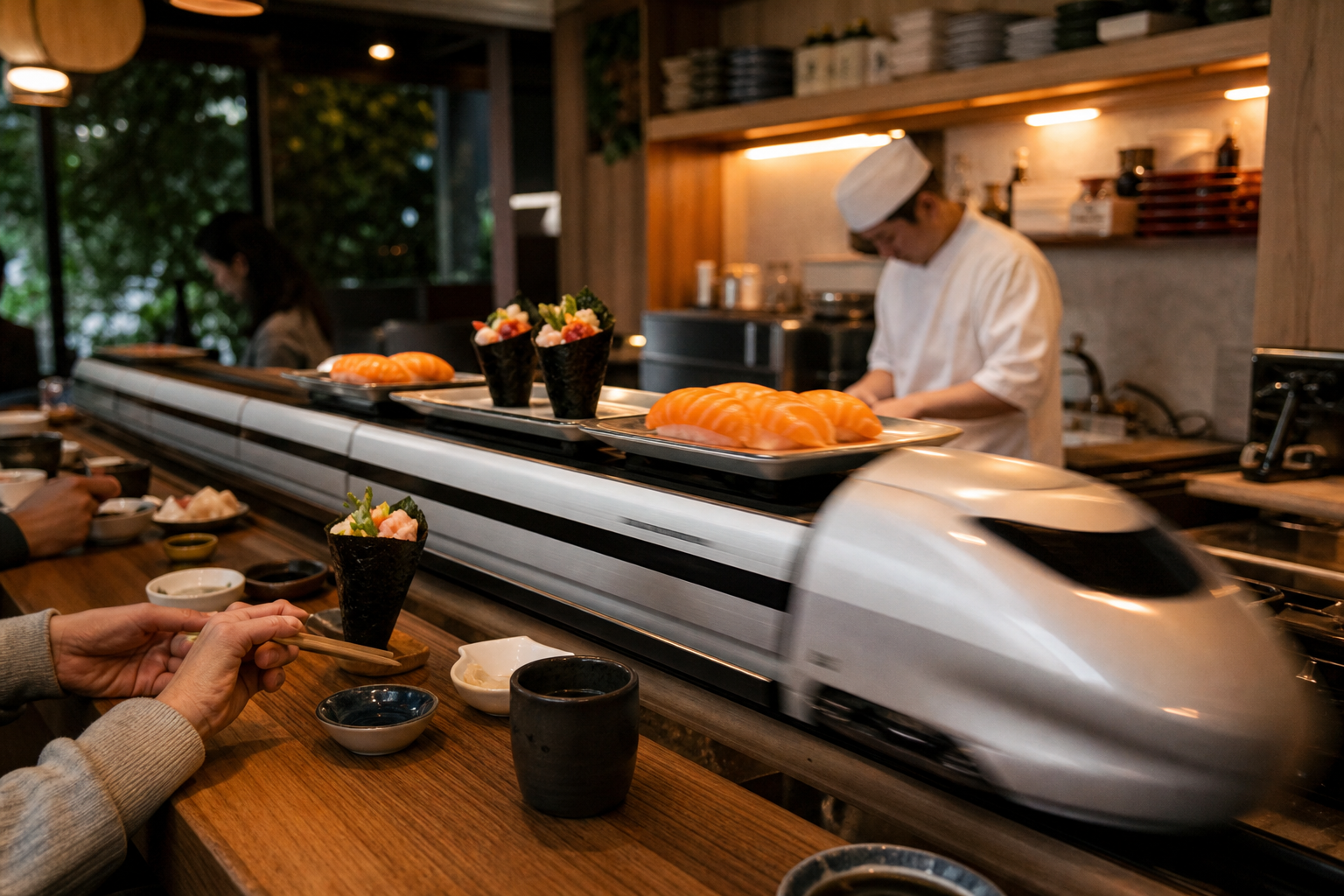
- Bullet train sushi is a modern kaiten-zushi format where dishes travel to the table on a miniature train track after ordering.
- The Vancouver signal is real: Sushi Aboard on Denman has social traction, including a recent TikTok tagged #bullettrainsushi.
- A simple salmon hand roll can work as the core item, but pricing needs to leave room for labour, waste, and the track experience.
Bullet train sushi is not just sushi
It is sushi with theatre.
In the modern version of kaiten-zushi, guests often order from a tablet and the food arrives on a miniature train track instead of a plain tray. Daily Hive’s Vancouver coverage of Sushi Aboard describes it as “conveyor belt sushi meets bullet train delivery.” That mix matters. It gives customers something to watch, film, and talk about.
In Vancouver, that is part of the draw. A recent TikTok from @withnatwong spotlights Sushi Aboard on Denman and tags it #bullettrainsushi. That kind of specific, named format is easier for people to remember than generic sushi. It becomes a destination, not just another dinner.
Why it is getting attention now
This trend fits three things Vancouver diners already respond to:
- Experience: OpenTable says experiential dining continues to rise.
- Social proof: TouchBistro reports 67% of Gen Z have used social media to decide on a restaurant.
- Value pressure: operators need a reason for higher menu prices in a high-cost market.
That last point matters. When rent, labour, and food costs are all tight, customers still spend if the meal feels worth it. A train delivery system gives you a built-in reason.
It also fits the current Vancouver feed. The posts around it are not about plain sushi. They are about something memorable, visual, and a little bit fun. That is why this format stands out.
Where the idea comes from
The broader format comes from Japan. The original conveyor-sushi concept, kaiten-zushi, is commonly traced to Osaka. The point was simple: make sushi more casual and accessible.
The modern “bullet train” version keeps that same logic, but adds a little speed and spectacle. Guests still get small plates. They also get motion, novelty, and a better show for the room.
That matters for a dining room because motion sells attention. Attention sells repeat visits.
A simple item that fits the format
For a Vancouver operator, the safest entry point is not a complicated omakase setup. It is a compact, recognizable item that travels well.
Salmon hand roll
Ingredients
- Sushi rice
- Rice vinegar seasoning
- Nori sheets
- Salmon
- Cucumber
- Avocado
- Sesame seeds
- Optional spicy mayo
Method
- Cook and season the rice.
- Cut nori in half.
- Spread a thin layer of rice on one side.
- Add salmon, cucumber, and avocado.
- Add a small line of spicy mayo if you want it.
- Roll into a cone and serve right away.
That basic structure matches a Gordon Food Service Canada hand-roll recipe: rice, nori, salmon, and a clean hand-held build.
If you want a second item, add salmon nigiri. It is simple, fast, and easy to portion.
How to price it without guessing
For a trend item like this, the mistake is pricing off vibes. Price off food cost and the experience you are delivering.
A good target for many full-service restaurants is a food cost of roughly 28% to 32% for a featured item. If the format includes novelty, the price can sit a little higher than a standard roll because the customer is buying the show too.
Here is a simple framework for a salmon hand roll:
| Item | Estimated food cost | Menu price | Food cost % |
|---|---|---|---|
| Entry version | $3.20 | $11.95 | 26.8% |
| Standard version | $3.80 | $12.95 | 29.3% |
| Premium version with better salmon or extra garnish | $4.50 | $14.95 | 30.1% |
A few notes:
- Use the lower price if you have strong volume and tight prep.
- Use the middle price if the item is part of a family-friendly dinner check.
- Use the top price if you are pairing it with a more polished room, better salmon, or a stronger visual presentation.
For nigiri, you can keep the math even cleaner:
| Item | Estimated food cost per piece | Menu price per piece | Food cost % |
|---|---|---|---|
| Salmon nigiri | $0.95 | $3.50 | 27.1% |
| Aburi-style salmon nigiri | $1.15 | $4.95 | 23.2% |
Those price points line up with current Vancouver menu signals around Sushi Aboard, where third-party listings show salmon and tuna nigiri at about $3.50, and premium nigiri like aburi sockeye salmon and unagi at higher prices.
What to watch before you copy it
This is a dine-in format first.
Before you build anything around it, check three things:
- Table turnover: does the train actually speed service, or does it slow the room down?
- Waste: are you overportioning because the item looks too small on the plate?
- Labour: does the format create more handwork than a regular sushi line?
If you do not track those three things, the concept can look busy while the margin quietly slips.
The bottom line
Bullet train sushi is gaining traction in Vancouver because it gives people a meal, a moment, and a reason to post. That can work well, but only if the numbers hold.
If you are testing a trend item like this, goodword’s POS and inventory tracking make it easier to see whether the train is bringing profit, not just traffic.
Questions owners ask
What is bullet train sushi?
It is a modern sushi service style where dishes are ordered digitally and delivered to the table on a small train track or similar motion-based system.
Is bullet train sushi the same as conveyor belt sushi?
They are closely related. Conveyor sushi is the older kaiten-zushi format. Bullet train sushi is a newer version that often sends items directly to each table.
How should I price a trending sushi item?
Start with a food cost target around 28% to 32% for a featured item, then adjust for labour, waste, and the extra value of the experience.
Sources
- Sushi Aboard: Vancouver restaurant serves sushi “Kaitenzushi” style | Daily Hive
- Top Dining Trends: Insights for Restaurants | OpenTable
- TouchBistro 2025 American Diner Trends Report
- Top Restaurant Tech Trends to Watch in 2025 | OpenTable
- A weekend in Osaka: A sensory feast in the nation’s kitchen | The Japan Times
- Spamon (Special Salmon) Hand Roll | Gordon Food Service
- Order Sushi Aboard (Denman) - Menu & Prices - Vancouver Delivery | Uber Eats
- Sushi - Products for Sale | Wholesale Club
- The Daily — Consumer Price Index, December 2025 | Statistics Canada
- Some reasons why your bar or restaurant bill might be higher - Statistics Canada
- Kaitenzushi
- Order Sushi Aboard (Denman) - Menu & Prices - Vancouver Delivery | Uber Eats
- 2026 Dining Trends Report: Top Restaurant Insights | OpenTable - OpenTable Blog
Test the trend item, then check the margin
If you are trying a bullet train sushi feature, track every plate, every prep cost, and every comp. The idea only works if the numbers stay clean.
Start with goodword →